My journey to minimize by use of big tech tools, find alternatives or just do without, elevated the question, “what about office documents; Doc writing, spreadsheets, slides, etc?” I’ve been hooked on Google Office for well over a decade, mostly because its free. But, are there options that provide similar capabilities and a reasonable cost… or even free?
These alternatives range from free (Open Source – community supported), freemium, and premium options. I focused on the free options.
What is interesting to me is that, because these are Open Source, a foundation of capabilities is available to whoever wants to build with it. Similar to how Chromium is the foundation of Chrome, as well as Brave, and DuckDuckGo browsers. In the case of Office Applications, I jumped into CryptPad, a France-based initiative.
How did I land on Cryptpad Collaborative Office Suite?
I had some criteria:
Security & Privacy. Up to this point, I accepted the Google will access all my docs, gather data about me and use this as part of the mega data profile it builds on all users and sells. But why should I just accept that? Oh, yeah… inertia.
Browser-based access and usage. I didn’t want to download an app (we used to call these ‘programs’). It has to function 100% in a browser.
Cloud storage. I don’t need much, but being able to store the documents and access from anywhere is important to me.
Decent user interface. I am not looking for a Google Business Suite clone. But, it has to be easy to navigate and at least somewhat intuitive.
Ability to share/collaborate.
Cryptpad Office Collaboration Suite has all of the above. It is not perfect, but then neither is Google. Also, because it is open source, you can go direct or use other organizations that implement CryptPad. I started with U.S. based https://unredacted.org. Then I switched to cryptpad.fr.
Office App Security & Privacy
As the name of the suite indicates, CryptPad is end-to-end encrypted. Wherever you decided to join, the data stored in the server – your documents – is encrypted. The host cannot read your documents. Your data is yours.
Like other online apps, your access is granted via user name and password. What is different is that CryptPad does NOT collect other information from you. No email, no phone number, no birth date, not even your name. Since they are not using the app to gather personal information for marketing or to sell like other organizations, they simply don’t collect it.
With Personally Identifiable Information (PII) being hacked across websites and platforms, CryptPad can’t be targeted in this way. Even if a hacker managed to breach the server, there is nothing to tell them who the users are or even be used to connect them to other data sources.
The downside? If you lose your user name or password, you’re screwed. There is no account recovery mechanism to which you can have a text or an email sent. CryptPad is very clear about this when you set up an account. It is the ultimate in personal accountability. A bit like a Swiss bank account only accessible if you have the number. Lose the number and lose the content.
Storage Space
The free version of Cryptpad provide one GB of online storage. Online docs don’t take much space, so for me 1GB is fine. You can also subscribe for more space of needed.
A feature I appreciate: When you create a new document, you can set trash-date. If you want, the document can be deleted automatically after 1, 2, 3 or more months. For me it is not so much a space issue as an organization issue. I work through ideas by writing and can pile up a lot of documents that are just working through a topic, or figuring out how i want to word something. I don’t need these; but I don’t actively delete them either. So, I tend to have a lot of junk. This auto-trash feature is perfect for a wondering mind.
Connecting with others
Connecting to other users is done by sending them your profile link, or getting thier profile link. Once you have it, you can send or accept a profile connection request. When both users agree to a connection, file can be share directly without using a share link.
File sharing with non-CryptPad users
You can use a share link to give someone else read or edit access. A neat feature is that you can provide a “view once.” If you want to get some feedback but not actually do a full collaboration.
By connecting with other people using CryptPad, you can share documents with their profile.
There are some known bugs in CryptPad. One us that spellcheck is does not always function. Fortunately, with the Rich Text Editor, the browsers built-in spell check will highlight spelling issues.
Our information is currency. It is used by large tech firms to monetize our activity, feed us a never-ending stream of influences, and create time-sucks that they can further use for monetization. Moving away from some of the big-tech solutions helps us mitigate the influence these companies have. So, where we can, we should find and support alternatives.
The reality of capitalism, whatever its strengths, is that it can be brutal on individuals. Our history is marred by mistreatment, exploitation, and abuse by companies against their workers and communities. These abuses are as well-documented as they are disturbing.
Early last century, companies writ large discharged workers when they became too old to continue working, after years of paying wages that were barely adequate for daily expenses. It was not a question of employees being disciplined and saving for retirement; they simply weren’t paid enough to be able to save. Old age or poor health often meant poverty so acute that suffering was assured, and the end of life soon followed.
The Answer: Social Safety Nets in The New Deal
During the 1920s and 1930s, the voices of the people were being heard in Washington, D.C. The efforts resulted in the New Deal and included the creation of the Social Security Administration. At that time, people’s well-being was finally put first.
“Among our objectives I place the security of the men, women and children of the Nation first.”
Franklin Delano Roosevelt – June 8, 1934 [1]
The premise of the Social Security System is straightforward: create a Social Security Trust (the Trust) funded by payroll contributions, split between employees and employers, to provide for people during retirement. It was not intended to be a mechanism for getting rich. It was to ensure people could retire without the threat of poverty.
In 1977, the US implemented an automatic increase in the salary cap to which Social Security taxes, or FICA, would apply. [2] In 1983, the Greenspan Commission reworked the SS system to ensure the trust could remain healthy. [3] The basic underpinnings of the plan were:
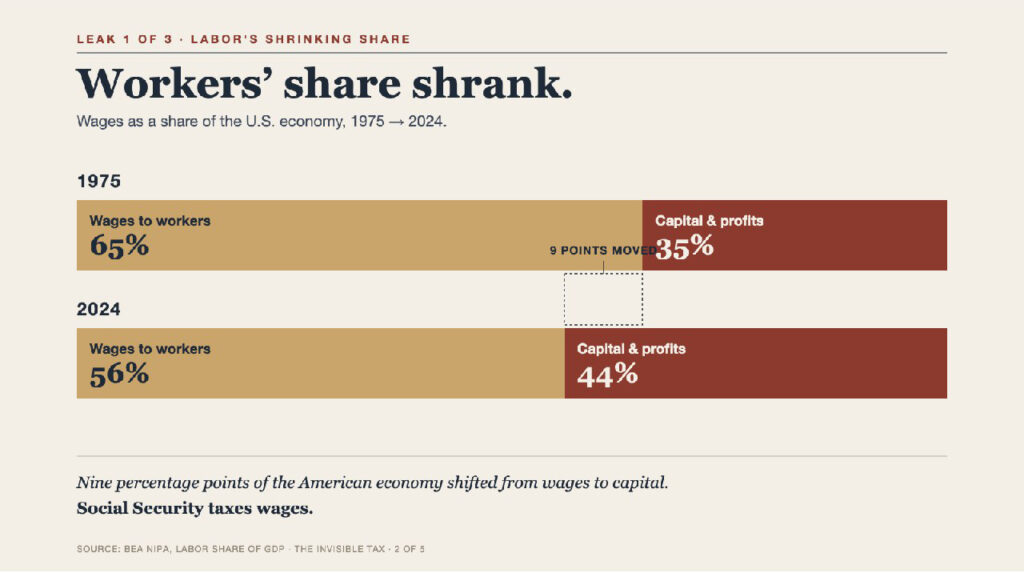
The wage pool remains about 65% of Gross Domestic Product (GDP) [4]
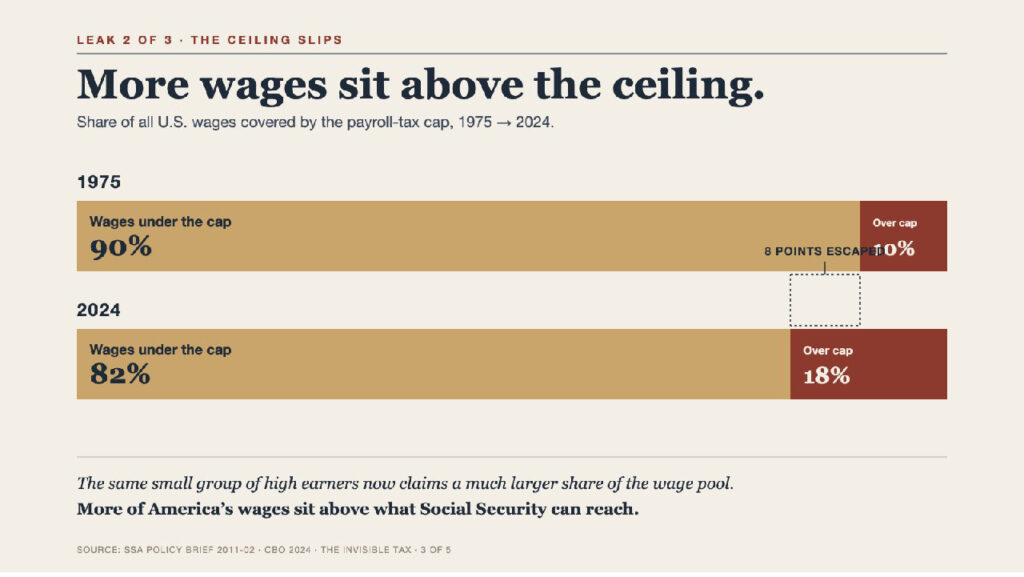
Social Security tax /FICA covers 90% of the wage pool [3]
Wage distribution remains steady, so the cap covers 90% ongoing [3]
At the time, roughly 6% of workers were paid wages that rose above the wage cap. [3]
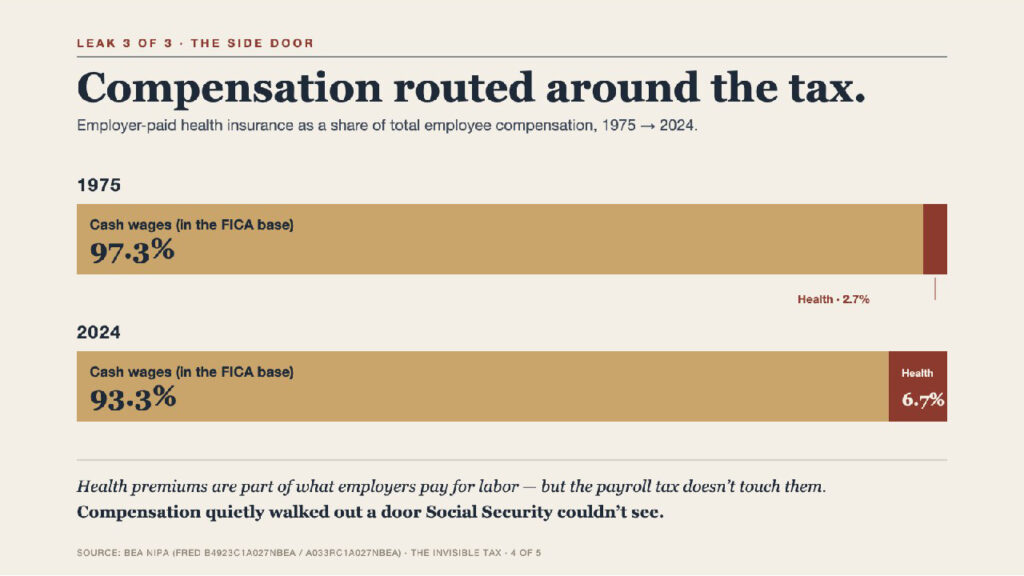
It is also important to note that health insurance benefits, which are part of the wage pool but not subject to FICA taxes, were about < 3% of the wage pool. [5]
Note on GDP: the GDP is the total value of goods and services produced within a country. Think of it as the country’s collective revenue or sales. The growth in GDP is a combination of increased productivity (i.e., workers produce $ 1,000 of goods per hour in one year, and then $1,050 the next; the productivity increase was 5%). There are components to productivity growth, but that’s the basic idea. The other component is inflation. That averages about 3.7% per year over 50 years. [6]
The Dismantling of our SSA Underpinnings
We are being told by Social Security Administration Commissioner Frank Bisignano and Centers for Medicare and Medicaid Services (CMS) Administrator Mehmet Oz, the current administration, as well as companies and many wealthy people, that the SS Trust Fund is running out of money because too many people are reaching retirement age. Their solutions are to tell us to work more years and accept fewer benefits. Their solutions ignore the underlying reasons the Trust is having trouble.
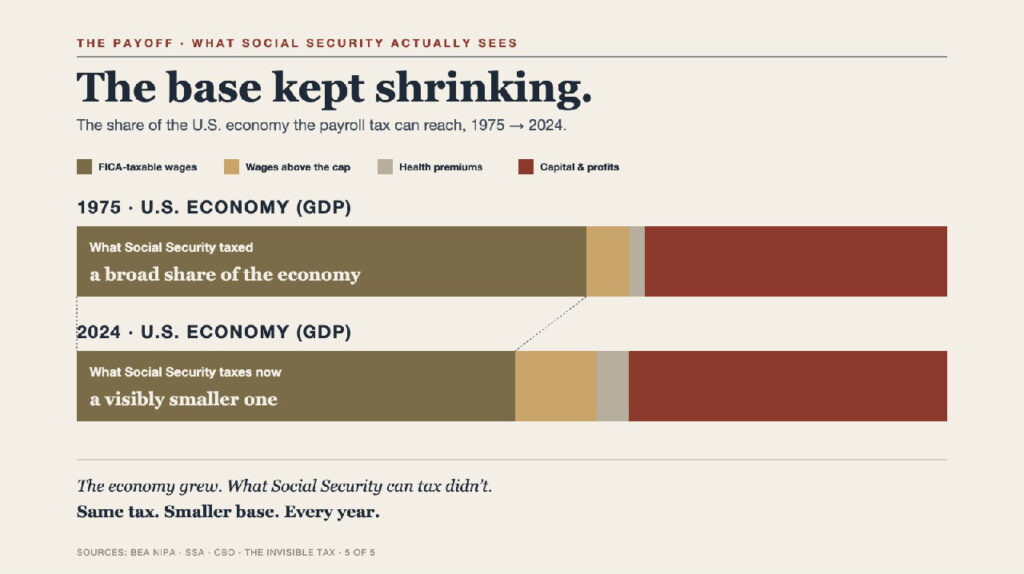
The primary factors in the erosion of trust involve the transfer of wealth from the workers in the wage pool to the wealthier people in the country. This isn’t a left-wing mantra. It’s math. It also has implications beyond SS.
The Proportional Decline of the Wage Pool
When the Greenspan Commission developed the new framework for keeping the Trust funded, a key assumption was that the Wage Pool would continue to be 65%-68% of the GDP. In other words, the share of the country’s income split between companies and workers would follow its historical pattern. That did not happen.
Wage Pool Declined 14% Relative to GDP
1975, it was 65% of GDP. [4]
2026, it was 56% of GDP. [4]
As workers became more productive and the GDP grew, companies increased profits at a much faster rate than wages. By 2024, the Wage Pool was down to 56% of GDP. [4]
More of Wage Pool Consumed by Higher Earners
The Commission’s projections assumed the Wage Pool split would remain stable, allowing automatic caps to maintain 90% coverage of wages. That did not happen.
Social Security Tax Cap Coverage Drops 8.8%
1983, it covered 90% of wages [3]
2024, it covered 82% of wages [3]
By 2024, the FICA wage cap coverage fell to 82%. [3] This happened because higher-income earners saw their wages increase at a faster rate than those of the general working population. We did not see a proportional increase in the number of workers who were raised above the cap.
In 1983, 6% of workers had salaries above the pay cap. In 2024, that percentage was the same. [3] 6% have wages above the cap, and 94% have wages below the cap. The FICA coverage dropped from 90% to 82% because wages were disproportionately funneled to high-income employees.
This had a material impact on the Trust. If a worker earns $50,000 a year and receives a 10% wage increase, the full $5,000 increase is subject to FICA taxes and helps fund the Trust. If an employee earns $1,000,000 and receives a 10% wage increase, none of the $100,000 increase is taxed.
Because the wealthier got disproportionately wealthier, there was a very real negative impact on the Trust.
The Health Insurance Impact
Unlike every other country, employer-sponsored health insurance is part of the US wage pool. But since the insurance premiums are excluded from FICA, money spent on health insurance does not contribute to the Trust. Over the past 50 years, this has negatively impacted the Trust balance.
A relative 100%+ Growth in Health Insurance
In 1975, untaxed Premiums were <3% of the Wage Pool [5]
In 2024, untaxed Premiums were ~7% of the Wage Pool [5]
Health insurance premiums in 1975 accounted for less than 3% of the wage pool. [5] The cost of health care rose faster than the GDP (of which it is a part). As a result, health insurance premiums accounted for about 7% of the Wage Pool in 2024. [5] That is an additional 4% of the Wage Pool no longer contributing to the Trust.
The Trust Could Be Fully Funded & FICA Tax Lower
The Trust funding deficit is about $41B per year. [7] There are several ways to view the three key factors and to address their impact on the Trust funding deficit.
If our experience had matched all the assumptions of the Greenspan Commission, the Trust would be flush. I’ll show the math for these, but here is what was planned that didn’t happen.
If:
The wage pool had kept pace with GDP, FICA tax revenue would be + $190B/year; [8]
The tax cap covered 90% of wages, FICA tax revenue would be + $115B/year; [8]
The Health Care Ins was still 2.7%, FICA tax revenue would be + $50B/year. [8]
If all three remained in the same ratios as 1983, the combined impact would be +$387B / year. [8]
How Much GDP would have to stay in wages to fund the Trust?
With Health Insurance Premiums held at 7% of the Wage Pool and the tax cap still covering only 82%, the Wage Pool’s share of GD would need to be only 58% vs the current 56%. [8]
This would bring the labor from $16.2T to $16.8T, generating an additional $42B to fully fund the Trust.
So, instead of cutting labor share from 65% of GDP down to 56%, if it were 58%, our SS Trust would be fully funded.
Mechanisms Behind the Shift
I am not going too deep into the elements that encouraged the shift. Part of it is the cultural acceptance of the wealthy’s edict and changes to the legal standing of companies and organizations per rulings of the Supreme Court in the 1970’s.
SCOTUS 1976 ruling: Money equals speech – opened the path to unlimited political spending. [9]
SCOTUS 1978 ruling: Corporations have the same speech rights as individuals. [10]
Top marginal tax rate cut from 91% (1960) to 28% (1986), now 37% [11]
Union membership collapsed from 35% to < 10% [12]
Financialization: stock market became the dominant wealth engine
Globalization compressed middle-class wages
The first two points opened the door for corporations, organizations, and very wealthy individuals to influence politicians and legislation in ways average individuals cannot. The changes we’ve seen over the last 50 years have been much more favorable for the upper class and large companies. This is a direct result of their influence on our representatives.
Flexibility for Funding the Social Security Trust
While I looked at GDP as a source of funding for the Trust, the fact is there is plenty of money in the economy to fund the Social Security program. It’s a question of the willingness of those with power and wealth to do so. The fact is, the SS Trust could be easily funded with a $29T GDP. [13] We are talking about $41B.
When the upper class tells you that you are the problem because you don’t work enough, don’t accept it. They are the problem. They made these decisions, diverted GDP, increased their wages, and detracted from the Trust.
Sources
[1] Franklin D. Roosevelt Presidential Library. Franklin D. Roosevelt, message to Congress on the objectives and accomplishments of the administration, June 8, 1934. Franklin D. Roosevelt Presidential Library & Museum. https://www.fdrlibrary.org/documents
[2] SSA, Legislative History of Social Security. Social Security Administration. “Automatic Increases in the Contribution and Benefit Base — Legislative History.” 1972 Social Security Amendments introduced automatic annual indexing of the taxable earnings base, first applied in 1975. https://www.ssa.gov/oact/cola/AWI.html
[3] SSA Policy Brief 2011-02 (Whitman & Shoffner). Social Security Administration. Policy Brief No. 2011-02, “The Evolution of Social Security’s Taxable Maximum,” September 2011. Source for the 1983 Greenspan Commission target of 90% covered-earnings coverage, the drift to ~82% today, the persistence of ~6% of workers earning above the cap, and the cap-to-average-wage-ratio history. https://www.ssa.gov/policy/docs/policybriefs/pb2011-02.html
[5] BEA NIPA via FRED (health insurance share of compensation). Bureau of Economic Analysis, National Income and Product Accounts. FRED series B4923C1A027NBEA (Employer Contributions for Group Health Insurance) as a share of A033RC1A027NBEA (Compensation of Employees). Health share of compensation: 2.7% in 1975; 6.7% in 2024. https://fred.stlouisfed.org/series/B4923C1A027NBEA
[6] BLS CPI-U, 50-year average inflation. Bureau of Labor Statistics, Consumer Price Index for All Urban Consumers (CPI-U). Compound annual inflation rate from 1975 through 2024 is approximately 3.8% per year. https://www.bls.gov/cpi/
[7] 2024 OASDI Trustees Report. Social Security & Medicare Boards of Trustees, 2024 Annual Report of the OASDI Trustees. The Trust ran a cash-flow deficit of approximately $41 billion in 2023; the trust fund is projected to be depleted in 2034. https://www.ssa.gov/oact/tr/2024/
[8] Section VI math worksheet (2026-07-03). Author’s calculation. Each counterfactual holds all other channels at current values and rolls a single factor back to its 1975/1983 pattern; results are calibrated so the reconstructed 2024 baseline matches actual OASDI payroll-tax receipts (~$1.18T per the 2024 Trustees Report). Underlying inputs from BEA NIPA, SSA Policy Brief 2011-02, and the 2024 Trustees Report.
[9] Buckley v. Valeo (1976). Buckley v. Valeo, 424 U.S. 1 (1976). The Supreme Court struck down mandatory limits on independent political expenditures on First Amendment grounds, establishing the money-as-speech doctrine that opened the way to later expansions such as Citizens United (2010). https://www.oyez.org/cases/1975/75-436
[10] First National Bank of Boston v. Bellotti (1978). First National Bank of Boston v. Bellotti, 435 U.S. 765 (1978). The Supreme Court held that corporations have First Amendment speech rights in the context of political spending on ballot initiatives, extending the free-speech protections of natural persons to corporate entities. https://www.oyez.org/cases/1977/76-1172
[12] BLS union membership series. Bureau of Labor Statistics, “Union Members Summary,” annual releases; historical series compiled by unionstats.com (Hirsch & Macpherson). Combined public+private union density peaked near 34.8% in 1954 and had fallen to ~10.0% by 2023. https://www.bls.gov/news.release/union2.nr0.htm
[13] BEA GDP (2024). Bureau of Economic Analysis, National Income and Product Accounts, Table 1.1.5. Nominal U.S. GDP in 2024 was approximately $29.0 trillion. https://www.bea.gov/data/gdp/gross-domestic-product
Google is looking to cut the pay of remote workers.
No, not hire remote workers at lower pay. But, those workers who went remote during COVID and they and their bosses realized they can do the work just as well if not better. The workers who had an agreement with Google about their pay. Yeah, they’re looking at a pay cut.
From NY to Seattle, Google is saying that since you are no longer communicating 2 hours each way, your pay should be based on the town in which you live… the one in which you’ve been living since you started working at Google.
Google places its office in expensive downtown locations. By letting employees work remotely, they can cut office space and save money. However, they are maximizing profits by minimizing costs for employees as well, if they can.
Employees are just assets
Once again we are reminded that employee loyalty to a company is unwarranted, particularly in large companies.
We get sucked into the “my boss is a great person” trap, attributing the attitude of the boss to the company.
Large companies, public companies particularly, are designed to do one thing, make as big a profit as possible. They will quickly and easily let employees go, cut their hours, reduce the benefits, and cut the pay of the can.
This is not a slight on big companies, but an acknowledgment of their reality. It is what they are.
Google can reduce costs by reducing workspace in high-rent markets if they allow employees with long commutes to work at home without a penalty. But, they’ve come up with this BS notion that they will cut pay based on where the employee lives.
The value of the work to the company hasn’t changed. The value of the employee to the company may actually improve. But, the business decision is to seek to reduce costs. That is great for Google and its shareholders. Not so much for employees.
Lesson: Do what you have to do for your good and the good of your family. Google, any large company, will be fine if you have to make changes. The days of the “lifer” are long past.